Data & AI Report – Data Trends in October 2024

November 13, 2024

1510

Data trends in October saw impressive investments, cleantech advancements, AI assistants and most excitingly, robots! 

We’ve delved into the most exciting news from the month – check them out below 👇

European Innovation Council to Boost Deep Tech Innovation with €1.4 Billion Investment in 2025 

The EIC has announced an impressive €1.4 billion investment: a huge boost to deep tech research and strategic technology start-ups across Europe for 2025. This increase represents a massive €200 million boost compared to 2024, underscoring the EU’s commitment to nurturing high-potential tech ventures that will shape Europe’s technological future. 

By improving access to capital, the EIC is actively working to bridge the funding gap that often limits the growth of Europe’s tech pioneers and hinders their global competitiveness. This offers a critical opportunity from European startups – we’re excited to see what this brings! 

Read more about the 2025 EIC programme here. 

Lunar’s AI Voice Assistant to Handle 75% of Customer Calls, Revolutionising Fintech Support 

Danish challenger bank Lunar takes major step forward in customer service by launching a voice assistant powered by AI. Aiming to handle  75% of customer calls, Lunar’s AI assistant promises a seamless 24/7 experience. Accessible answers even in the middle of the night!

Lunar’s move echoes a growing trend among fintechs (including Klarna and Bunq) who are using AI to streamline customer support without cutting jobs. With its forward-thinking approach and a valuation of $2.2 billion, Lunar is positioning itself at the forefront of fintech innovation in the Nordics, aiming to enhance customer service without sacrificing the personal touch. 

See Lunar’s press release here. 

Cleantech Companies Secure a Huge €13.2 billion in Funding in First Three Quarters of 2024 

Cleantech companies are at the forefront of Europe’s drive for sustainability: they are spearheading efforts to reduce carbon emissions and transition toward a circular economy. Their innovative work in renewable energy, sustainable materials, and resource management is not only crucial for environmental resilience but also fuels job creation and economic growth across the continent. 

These investments highlight the strong momentum behind green technologies and signal continued interest in sustainable growth from investors. With support like this, Europe is laying the groundwork for a cleaner, more sustainable future, one that aligns environmental priorities with economic opportunity. 

Check out a few of the companies that were involved in raising the funds: 

Northvolt // Avantium Technologies // BioBTX 

Starship and Bolt Team Up for Robot Grocery Deliveries in Tallinn 

Make way for the robot! 

Estonian-founded tech leaders Starship Technologies & Bolt have joined forces to launch Europe’s first robot-powered grocery delivery service – a huge push forward! 

This groundbreaking service combines Starship’s autonomous delivery robots with Bolt’s popular delivery app. Starship’s robots, consume minimal energy—about the amount needed to boil a kettle for a cup of tea. The robots offer a more sustainable option to usual deliveries – we have no doubt this will quickly spread throughout the rest of Europe! 

Conclusion

Europe is rapidly advancing through strategic investments, cutting-edge AI applications, and innovative green solutions. It’s setting a strong foundation for future growth in high-impact sectors and the developments signal a promising era of sustainable innovation, economic opportunity, and technological leadership across Europe. 

Check back to see what data trends we see develop next month.

Data & AI Report – Data Science Trends September 2024

October 9, 2024

1510

September trends in data science saw introductions into advanced search engines, internal developments & data protection from potential AI threats.

We’ve covered some exciting news from some big names.

Read on for more on all these exciting developments!

Vinted migrate to Vespa – how the online second hand shopping phenomenon is keeping up with the growth & complexity of data

After hitting the limits of their previous search engine, Vinted were on a mission to find a more scalable alternative.

Introducing Vespa: an open-source search engine & vector database. Vespa supports vector and keyword search and searches within structured data, all in one query. It also integrates machine learning which enables real-time AI insights from their data. It’s proven to handle thousands of queries per second, making it the top-runner for managing large & complex data.

Already used by others including Spotify & Yahoo and with continuous application improvements being delivered, will we continue to see increased use of Vespa?

Read more about Vinted’s migration here.

QueryGBT – allowing easier and faster data analysis for Uber

Uber’s data platform handles a huge 1.2 million interactive queries each month. The idea of QueryGBT is to better manage real-time data analytics & to query massive datasets. A combination of Presto (open-source SQL query engine) and Apache Hudi, which has the capabilities for handling upserts and managing large volumes of data in a cloud-based or distributed environment.

The system is part of Uber’s broader efforts to handle large-scale, real-time data streaming and querying – integral to its data-driven approach to decision-making. It’s said to minimise generating reliable queries from 10 minutes down to 3 which is a massive productivity gain for Uber.

Using advanced AI, QueryGPT fits smoothly into Uber’s data system, cutting query time and increasing accuracy to handle their complex data needs.

Read more about the advancements here.

Dropbox & Lakera Guard securing LLM’s

In a blog posted this September, Dropbox delved into how they’re using Lakera Guard to protect their LLM’s from potential security threats posed by AI.

Citing the importance of maintaining the trust of their millions of users to protect their content, Dropbox talk about how they chose Lakera Guard last year to protect user data & uphold the reliability and trustworthiness of their intelligent features, as outlined in their AI principles.

What were Dropbox looking for in their quest for protection? Their considerations concluded that it has to be deployable on their existing infrastructure, have low latency, strong confidence scores and scope for continuous improvement.

Dropbox have since invested in Lakera Guard, proving their strong belief in it’s abilities. Furthermore, they’ve also collaborated with the teams to develop improvements on the software itself. Working closely with Lakera, Dropbox have been able to help them meet their requirements whilst achieving their own security goals, too!

Read the full blog here.

Conclusion

In today’s fast-paced digital landscape, companies like Vinted, Uber and Dropbox are navigating many complexities. Vinted’s switch to Vespa demonstrates the importance of scalable search engines as companies grow. Uber’s QueryGBT highlights the need for faster and more accurate data analytics. Meanwhile, Dropbox’s partnership with Lakera Guard emphasises the need to secure AI systems to ensure data remains protected as AI technologies advance.

Data Jobs in the Netherlands

Interested in a new adventure within the data world?
For information on data jobs in the Netherlands, get in touch.

Data & AI Report – Data Science Trends July 2024

August 5, 2024

1510

Trends in data science have brought a fresh wave of excitement to the data and analytics landscape this July. We’re seeing major moves towards scalability, efficient governance, and AI capabilities. Additionally, Dr. Randy Olson shows us just how far creative data use can take you—literally! Turns out, data science isn’t just about numbers, it can plan one epic road trip too! 

Firstly, discord’s transition to Dagster and dbt for data orchestration 

This month, Discord announced a major overhaul of their data orchestration infrastructure, moving from their in-house system, Derived, to a combination of Dagster and dbt. As their platform and user base expanded, the need for enhanced self-service capabilities and robust observability became evident. This decision was driven by the necessity for declarative automation, a modern unified interface, reliability on Kubernetes, and seamless integration with existing tools. 

After evaluating open-source options like Argo and Prefect, Discord chose Dagster for orchestration and dbt for data modeling. This transition has enabled them to support over 2,000 dbt tables, enhancing their ability to deliver seamless service and insightful data analytics while scaling efficiently. 

Read about it here

Meta unveils Llama 3.1 

This month, Meta introduced Llama 3.1, a massive leap in open-source AI. The Llama 3.1 405B model brings unmatched flexibility and state-of-the-art capabilities, unlocking new workflows like synthetic data generation and model distillation. Additionally, Meta is enhancing the Llama ecosystem with new security tools and a reference system. Over 25 partners, including AWS and Google Cloud, will offer services from day one. 


Llama 3.1 models feature expanded context lengths to 128K, multilingual support, and strong performance across benchmarks. Upgraded 8B and 70B models enhance capabilities in general knowledge, tool use, and translation. 

Read Meta’s full update

Building a data-driven analytics team at DoorDash 

Jessica Lachs, DoorDash’s VP of Analytics & Data Science, shares insights on what it means to be truly data-driven and how to structure an analytics team. Having joined DoorDash as the first General Manager in 2014, Lachs has built the analytics team from the ground up and now leads global analytics, including the Wolt Analytics team post-acquisition. 

Not only does Lachs highlight that the term “analytics” can be ambiguous, encompassing data science, business intelligence, product analytics, machine learning, and BizOps. She also emphasizes that to build a data-driven organisation, founders should focus on desired outcomes rather than semantics. At DoorDash, the role of analytics has evolved with the company’s growth, shifting from gut instinct decisions to data-centric strategies. Initially, DoorDash used quasi-experimental methods due to limited data, but as the company matured, they invested in scalable data models and advanced experimentation capabilities, expanding their analytics scope to drive better decision-making. 

Read the full post here

Databricks’ migration to unity catalog for data governance 

In a recent blog post, the Data Platform team at Databricks shared insights into their migration to Unity Catalog for enhanced data governance. As the company grows, establishing secure, compliant, and cost-effective data operations has become a priority. With thousands of employees analysing data, consistent governance standards are essential, making the migration to Unity Catalog a top priority. 

The blog outlines the challenges and benefits of migrating from the default Hive Metastore (HMS) to Unity Catalog. While HMS lacked fine-grained access controls, lineage support, audit logs, and effective search integration, UC provided these features out-of-the-box. Therefore, the team chose a transformational approach, selectively migrating datasets to establish a structured governance framework. This strategy required more effort initially, but enabled clear data ownership, naming conventions, and intentional access, setting the stage for future governance policies.

Read the blog

Finally, some creative Data use!

Dr. Randy Olson, a full stack data scientist and AI researcher, utilised his expertise in machine learning to develop an optimal search strategy.  

He approached this task using the Traveling Salesman Problem (TSP) algorithm, which aims to find the shortest route that visits each city exactly once and returns to the starting point.  

Dr. Olson applied three specific restrictions:  

  1. The trip must stop in all 48 contiguous U.S. states 
  2. Only visit National Natural Landmarks, National Historic Sites, National Parks, or National Monuments #
  3. Be taken entirely by car without leaving the U.S. 

Want to take the trip? The route spans 13,699 miles and requires 224 hours (or 9.33 days) of driving, assuming no traffic. You can find the full itinerary here. 

Dr Randy Olsen used Data to design the optimum road trip across the U.S. Showing how useful data can be. Data science trends really are everywhere!

Olsen’s epic road trip

To conclude 

July highlighted several key trends in data and analytics. The push for scalability is evident in Discord’s adoption of Dagster and dbt, and Databricks’ migration to Unity Catalog for better data governance. The importance of building effective data teams was underscored by DoorDash’s approach to analytics leadership. Another notable trend is the growing emphasis on enhanced self-service capabilities and robust observability in data platforms. These themes point towards a future focused on scalable infrastructure, efficient governance, structured teams, and innovative AI applications.

If you’re interested in how we can help scale your data team, get in touch.

Dutch Recruitment Trends and Skills to Watch 👀

May 21, 2024

1510

If you’ve had anything to do with recruitment in the Netherlands over the past year, you’re probably well aware that it’s been a bumpy ride. 

However, it looks like the clouds are parting (finally!), we’re seeing more roles on the market, and lots of highly-qualified candidates to fill them! We’re on the brink of some very exciting times, with lots of new roles and exciting developments coming this year. Read on for our take on the dutch recruitment trends and skills you need to watch for the second half of the year. ⬇️

What are the key trends? 

We’re seeing a major shift in the Dutch labour market, fueled by automation, artificial intelligence (AI), and data analytics.  

Data and AI are being increasingly integrated into daily business operations, and only the companies that act fast will be able to get ahead. 

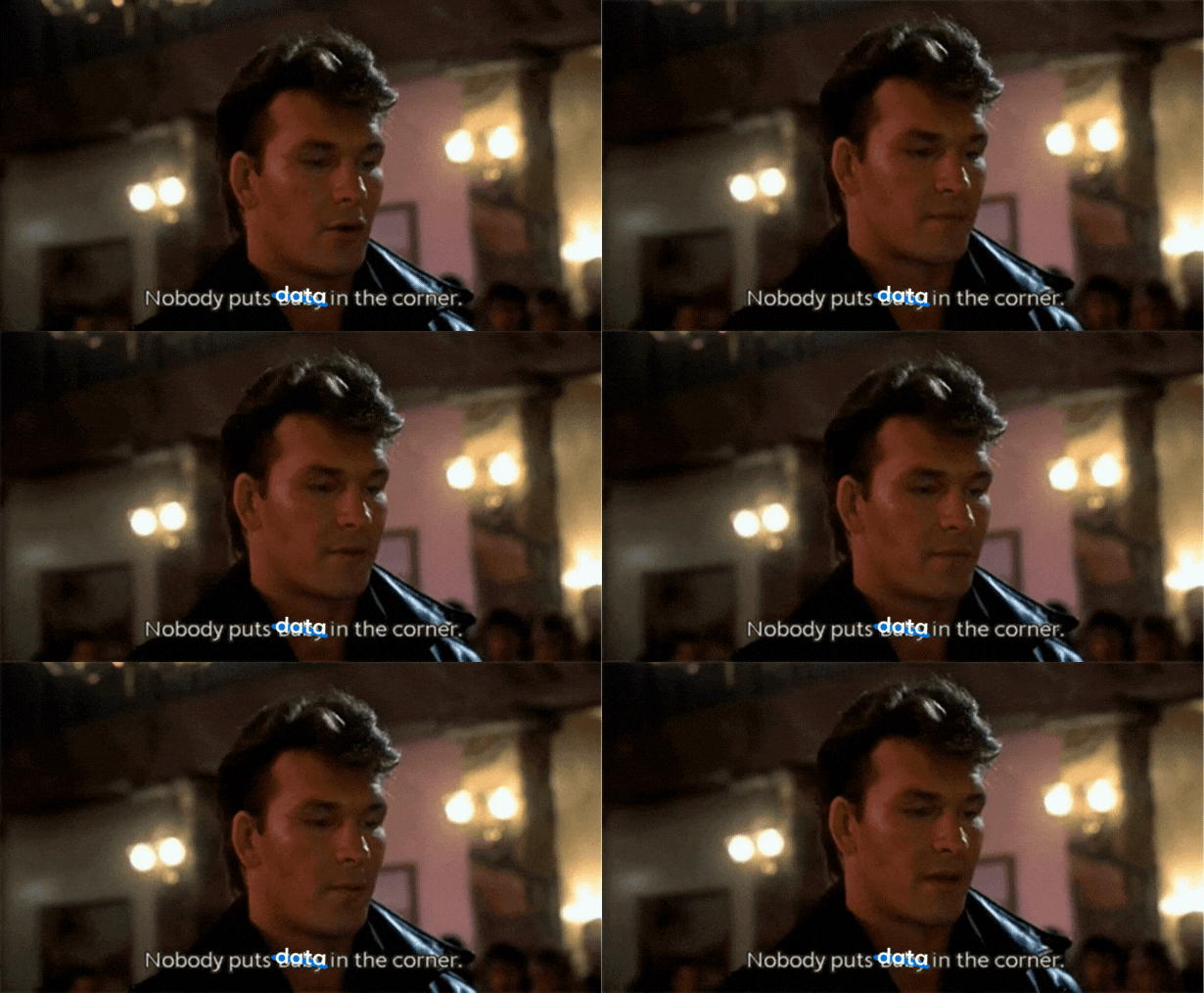
GIF of Patrick Swayze's character, Johnny Castle in Dirty Dancing, with the caption 'nobody puts baby in the corner' - the word 'baby' is covered and replaced by the word 'data'. Nobody put's data in the corner. Relating to the fact that data used to be separate within companies, but it's being increasingly included in business operations.

Gone are the days of data being a secluded department in the shadows.

What Does This Mean for the Dutch IT Market? 

DATA TRENDS

In an effort to keep up with technological advancements and shifts towards more data-driven practices, we’re seeing more and more companies focusing on digital transformation projects, modernisation and streamlining of outdated processes. 

AI/ML TRENDS

Obviously, AI and ML technologies are taking over the world and it seems like companies are starting to realise that AI isn’t just a ‘fad’. It’s no longer about just keeping up with trends – for businesses that want to stay competitive and innovative, they’ve got to get ahead of their competitors and make use of all the technology available. There’s also huge potential for companies to boost team productivity, innovate and elevate customer experiences. 

In particular, we’re seeing companies in the FinTech, EdTech and EnviroTech spaces leaning into AI/ML. As a result, it’s likely that earlier adopters, who invest in this technology now, could end up being the unicorns of the future. 

CYBERSECURITY TRENDS

Given that The Netherlands is home to almost a third of Europe’s data centres (and Google starting work on a new data centre in Groningen this year!) clients recognise huge opportunities for growth.

On the flipside, with so much more of our data being processed online, the target for hackers is getting bigger and bigger. With this in mind, clients are expressing concerns around needs for improvement and investment in protection from cyber-terrorism. 

The Netherlands’ cybersecurity market is projected to continue increasing, from USD 2.16 billion in 2024 to USD 3.27 billion by 2029 (Security Insight).  

Does this mean we need to adopt a load of new languages or frameworks?  

Don’t panic!  

Python continues to reign supreme across all these areas, making it indispensable for most tasks. Candidates with a strong Python background often excel due to its simplicity and versatility, supported by over 135,000 libraries. 

Python’s role in data science, AI, ML, and cybersecurity is significant: with essential libraries like NumPy, Pandas, Scikit-learn, TensorFlow, PyTorch, and Scapy driving advancements. 

Candidates and clients we’ve spoken to recently highlight the importance of proficiency in C, Bash, and PowerShell for cybersecurity roles. They provide the low-level access and automation capabilities necessary for system programming, exploit development, and managing security operations.

Hiring managers frequently emphasise the value of candidates skilled in these areas to ensure teams are equipped to handle challenges effectively. 

However, staying ahead means being aware of other key players gaining traction: 

Data: 
  • Apache Spark, Snowflake, DBT for data transformation. 
  • Emerging tools like Polars and DuckDB. 
AI/ML: 
  • Hugging Face Transformers for NLP work. 
  • Julia for high-performance numerical tasks. 
  • Ray for scaling Python applications. 
Cybersecurity: 
  • Rust for secure application development. 
  • Tools like Darktrace and Cylance are leading in AI-driven threat detection. 
  • Burp Suite remains essential for web app security testing. 
  • Swift for system programming and security applications. 

What’s our advice? 

For candidates:

We’re advising Data candidates to focus on building skills in essential libraries like NumPy, Pandas, and TensorFlow. Also, engaging in data-centric projects helps build a strong portfolio while staying updated through online courses. 

As AI/Machine Learning are particularly sought after areas. As a result, we recommend enhancing your visibility by participating in competitions and contributing to open-source projects.  

For cybersecurity, focus on the tools we listed above, using these in personal projects where possible. What’s more, we’ve found that obtaining certifications like CISSP (Certified Information Systems Security Professional) or CEH (Certified Ethical Hacker) can be beneficial. 

For clients:  

Promote a culture of knowledge sharing through internal workshops and encourage team participation in industry events and conferences. This approach ensures your engineering team remains competitive and well-equipped to handle emerging challenges.

Investing in continuous learning and development not only keeps your team at the forefront of industry standards. It also aids in team collaboration and idea sharing helping keep staff engaged, crucial for retention. 

Finally, we recommend leveraging consultative recruiters (like Foxtek) to navigate technological advancements and avoid hiring mistakes. We focus our search on candidates familiar with key tools relevant to upcoming trends in each industry.

Wrapping up 

GIF of Lando Calrissian in Solo: A Star Wars Story with the caption 'you might want to buckle up, baby'. The gif is a joke referencing a line in the blog about how this is going to be a wild ride. We're expecting to see trends in the dutch market.

In conclusion, the next year is shaping up to be a wild ride. For tech professionals, the opportunities are vast and varied, with a strong push towards innovation, sustainability, and efficiency. Expect to see a load more companies looking to hire roles related to Data, AI, Machine Learning and Cybersecurity. 

On the other hand, for companies, adapting to these trends early will ensure you attract the right talent and stay competitive. 

Want to get ahead of the curve? Reach out to discuss your requirements, or check out our open roles.

contact our team.